• February

    10

    2026
  • 1016
  • 0
Guide How to Polish Marble Worktops?

Guide How to Polish Marble Worktops?

How to Polish Marble Worktops: Professional Methods vs DIY

Published: 9 February 2026 | Reading Time: 22 minutes | Expert Kitchen Marble Guide

Before and after photos showing etch marks from lemon juice on marble worktop completely removed through professional polishingIntroduction: The Appeal and Challenge of Marble Worktops

Marble kitchen worktops represent the pinnacle of luxury and sophistication in UK kitchen design. From classic Carrara to dramatic Calacatta, marble transforms ordinary kitchens into stunning culinary spaces that combine timeless elegance with natural beauty. However, this prestigious material presents unique challenges that every marble worktop owner must understand and address to maintain that showroom-perfect appearance.

Unlike synthetic worktop materials such as quartz or laminate, natural marble is a living stone that interacts constantly with its environment. Every food preparation session, every spill, every cleaning routine affects the marble’s appearance and condition. The very properties that make marble so beautiful—its soft, luminous quality and subtle variations—also make it vulnerable to the acids, oils, and physical wear inherent in kitchen use. Over time, even well-cared-for marble worktops inevitably lose their lustrous polish, developing the dull, worn appearance that prompts homeowners to seek restoration solutions.

This comprehensive guide examines both professional and DIY approaches to marble worktop polishing, providing the detailed information you need to make informed decisions about restoring your kitchen marble. Whether you are a homeowner in a period property with original Victorian marble, a luxury apartment resident with contemporary Calacatta worktops, or anyone else with dulled marble surfaces, understanding your options helps you achieve optimal results whilst making wise investments of time and money.

The fundamental question facing every marble worktop owner considering restoration is whether to hire professional services or attempt DIY polishing. This decision involves multiple factors including cost considerations (professional services typically cost £35-£65 per square metre for worktops), time availability, skill level, equipment access, and expectations for results quality. Throughout this guide, we provide honest, practical comparisons that help you evaluate which approach suits your specific situation.

We explore the complete professional marble worktop polishing process, examining techniques, equipment, and expertise that specialist companies employ. We provide detailed DIY instructions for homeowners considering self-polishing, including realistic assessments of challenges and limitations. Most importantly, we offer transparent comparisons of costs, results quality, time investments, and overall value propositions for both approaches, enabling you to make confident decisions about your marble worktop care. If you prefer to leave your marble worktop restoration to experienced professionals, visit our marble polishing services page to learn more or request a free consultation. 

What Makes Worktop Polishing Different

Polishing marble worktops presents unique challenges compared to marble floor polishing. Worktops require in-situ work around installed cabinetry and fixtures, involve extensive edge detailing that floors do not, demand close-up viewing quality as worktops are examined at arm’s length daily, and face intense use from cooking, food prep, and cleaning that creates specific damage patterns. These factors make professional worktop polishing costs 15-30% higher per square metre than floor polishing, but they also make results particularly noticeable and valuable.

Understanding Marble Worktop Deterioration

Before exploring polishing methods, understanding why and how marble worktops deteriorate helps you recognise problems early and make appropriate intervention decisions. Marble degradation in kitchen environments follows predictable patterns driven by the specific stresses of culinary use.

Chemical Etching from Acidic Substances

Etching represents the most common and visible form of marble worktop damage. This chemical reaction occurs when acidic substances contact the calcium carbonate-based marble, literally dissolving microscopic amounts of the surface and creating dull spots or rings. Kitchens present constant etching threats including citrus fruits and juices (lemons, limes, oranges, grapefruit), tomatoes and tomato-based sauces, vinegar and vinaigrettes, wine (both red and white), soft drinks and carbonated beverages, and some fruit-based foods.

Etching appears as dull, lighter-coloured spots on polished marble. Unlike stains, which add colour, etch marks simply create textural changes where the acid has roughened the previously smooth surface. Light etching feels smooth to touch but appears dull visually. Heavy etching may feel slightly rough and shows pronounced dulling. Distinguishing etching from staining is crucial, as the treatments differ significantly. For comprehensive guidance on addressing both staining and etching, refer to our detailed guide on removing stains from marble.

Mechanical Wear from Daily Use

Beyond chemical damage, marble worktops suffer mechanical wear from normal kitchen activities. Cutting directly on marble creates scratches and cuts (always use cutting boards). Hot pots and pans can cause thermal shock creating micro-cracks or discolouration. Abrasive cleaning with scouring pads or harsh scrubbers scratches the surface. General use friction from dishes, appliances, and food preparation gradually dulls high-contact areas.

This mechanical wear accumulates gradually, often going unnoticed until dulling becomes pronounced. High-use areas near sinks, around hobs, and in primary food preparation zones show wear first, creating visible traffic patterns where the once-uniform polish has disappeared.

Staining from Porous Marble

Whilst etching affects the surface texture, staining involves foreign substances penetrating into marble’s porous structure. Kitchen-specific staining sources include cooking oils and grease (particularly around hobs), red wine and dark beverages creating pink or brown stains, coffee and tea leaving tan discolourations, turmeric and strongly-coloured spices penetrating if spilled, and water minerals from hard water creating white deposits or rings.

Proper sealing significantly reduces staining risk, but even well-sealed marble can stain if spills remain too long or if the sealer has degraded. Combining staining with etching and wear creates the severely deteriorated appearance that prompts most polishing projects.

Sealer Degradation

Even if you avoid all the above problems, marble worktops face inevitable sealer degradation. The protective impregnating sealer applied to marble during installation or previous polishing services gradually breaks down from exposure to cleaning products, heat from cooking, water and moisture, and simple time. As sealer effectiveness diminishes, the marble becomes increasingly vulnerable to both staining and etching, accelerating visible deterioration.

Most quality marble sealers protect for 1-3 years in kitchen environments (less than the 5-10 years typical for flooring) due to the intense use and exposure kitchens present. Regular sealer testing and maintenance prevents deterioration from progressing to the point where extensive restoration becomes necessary.

Table 1: Common Marble Worktop Damage Types
Damage TypeCauseAppearancePolishing Difficulty
Light EtchingAcidic foods, wine spillsDull spots, lighter areasEasy (routine polishing)
Heavy EtchingProlonged acid exposureVery dull, textured feelModerate (requires grinding)
Surface ScratchesCutting, abrasive cleaningFine lines, dullingEasy to Moderate
Deep Cuts/GougesKnives, dropped objectsVisible grooves, damageDifficult (may not fully remove)
Oil StainsCooking oils, greaseDark spots, greasy appearanceModerate (requires stain treatment)
Water StainsHard water, mineral depositsWhite rings, cloudy spotsEasy
General DullingAccumulated wear, sealer lossLoss of gloss, flat appearanceEasy (standard polishing)

Professional vs DIY: Quick Overview

Before diving into detailed processes for each approach, this quick overview helps you understand the fundamental differences between professional and DIY marble worktop polishing, enabling preliminary assessment of which approach might suit your needs.

Professional Polishing

Key Characteristics:

  • Cost: £350-£650 typical kitchen
  • Time: 3-6 hours (one day)
  • Results: Mirror-like showroom finish
  • Guarantee: Typically 6-12 months
  • Equipment: Commercial-grade tools
  • Expertise: Trained specialists

Best For:

  • Severely damaged worktops
  • Valuable marble (Calacatta, Statuario)
  • Large worktop areas (8+ m²)
  • Time-sensitive situations
  • Perfect results required
  • Complex edge profiles

Ready to restore your marble worktops? Explore our comprehensive marble polishing and restoration services to see how we can help.

DIY Polishing

Key Characteristics:

  • Cost: £100-£200 equipment + materials
  • Time: 6-12 hours (weekend project)
  • Results: Good to very good
  • Guarantee: None (self-responsibility)
  • Equipment: Consumer tools
  • Expertise: Learning curve involved

Best For:

  • Light to moderate wear
  • Standard marble (Carrara, Crema Marfil)
  • Small worktop areas (3-6 m²)
  • Budget-conscious homeowners
  • Those with DIY experience
  • Simple edge profiles

The Hybrid Approach

Many experienced homeowners adopt a hybrid strategy combining professional and DIY efforts for optimal value. This approach involves hiring professionals for initial restoration or severe damage correction to establish perfect baseline, then using DIY maintenance polishing between professional services to extend intervals, and calling professionals again every 3-5 years for comprehensive restoration.

This hybrid approach maximises value by leveraging professional expertise for complex work whilst using DIY maintenance to extend expensive professional service intervals from 2-3 years to 4-6 years, potentially saving hundreds of pounds over time.

The Professional Marble Worktop Polishing Method

Understanding professional marble worktop polishing techniques helps you appreciate what goes into quality work and sets realistic expectations if you engage professional services. Professional worktop polishing represents specialised work requiring specific skills beyond general floor polishing due to unique challenges kitchen worktops present.

Stage 1: Pre-Service Assessment and Protection

Professional worktop polishing begins with thorough assessment where experienced technicians inspect the entire worktop surface, noting all damage, identifying stains requiring special treatment, checking edge condition and any chips or cracks, assessing the marble type and current finish, determining appropriate restoration depth, and photographing before-condition for comparison.

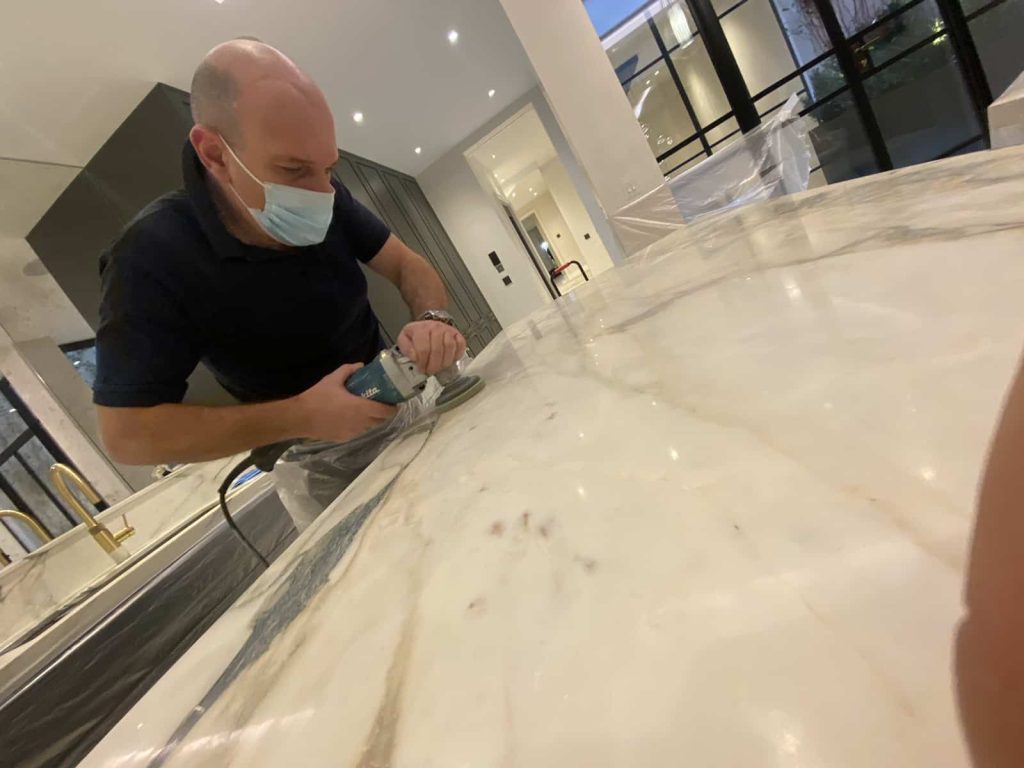
Protection follows assessment, involving masking off cabinets, appliances, and walls, protecting sinks and any fixtures, laying protective sheeting for surrounding floors, and setting up dust extraction systems. Whilst worktop polishing generates less dust than floor work due to smaller area, proper protection remains essential for clean professional results.

Stage 2: Deep Cleaning and Stain Treatment

Before polishing commences, professionals deep clean the entire worktop using pH-neutral cleaners specifically formulated for marble, removing all grease, grime, and cooking residue, eliminating old sealer if necessary, and treating stains with appropriate poultices based on stain type.

Stain treatment may require several hours or even overnight for deep-set stains, with this prep work occurring before main polishing to ensure clean surfaces for optimal results. Professional stain treatment uses commercial-grade products and techniques not available to consumers.

Stage 3: Grinding and Honing

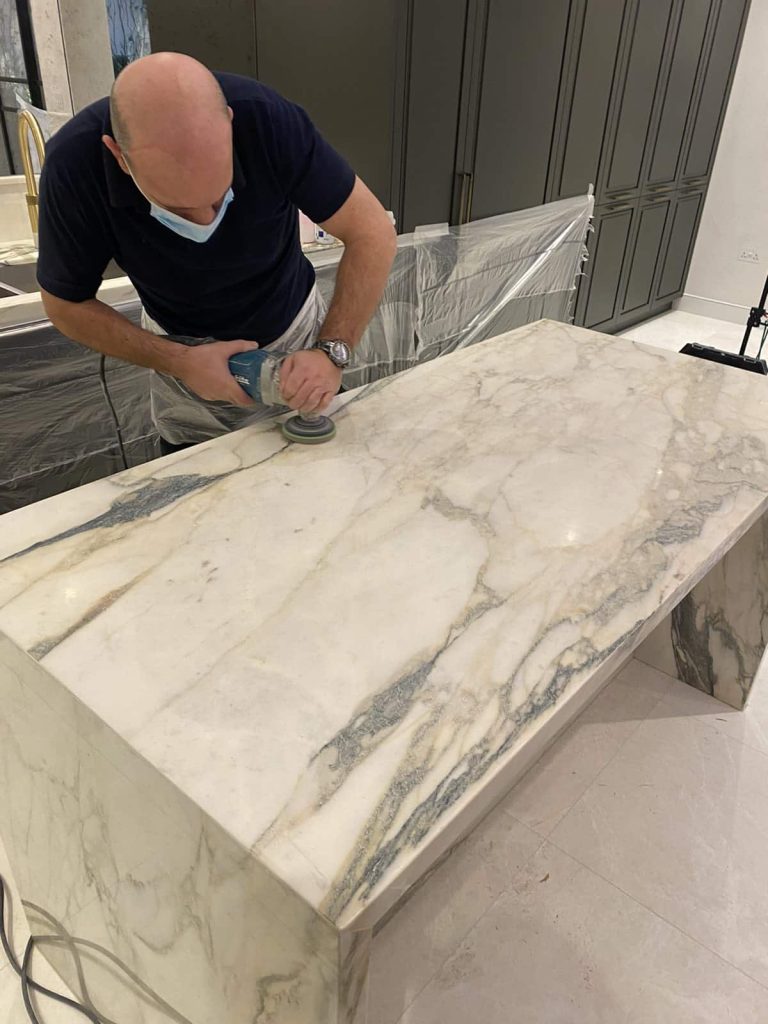
The grinding stage removes damaged surface layers and creates the foundation for final polish. Professional worktop polishing typically employs variable speed angle grinders or small rotary polishers fitted with diamond pads, as full-size floor machines cannot navigate around sinks, hobs, and other worktop fixtures.

Professionals work systematically across the worktop surface using progressive grit sequences typically starting at 200-400 grit for moderately damaged worktops, 100-200 grit for severely etched or scratched marble, or 400-800 grit for worktops needing simple refresh. Each grit stage requires multiple passes in different directions to ensure complete scratch removal from the previous level.

The Edge Work Challenge

Worktop edges present the greatest technical challenge in professional polishing. These visible, often-touched areas must match the field finish quality but require different techniques. Professionals use hand-held edge polishers or carefully-controlled angle grinders to polish edges, employ flexible diamond pads for curved or profiled edges, and hand-polish intricate details that machines cannot reach. Edge work typically accounts for 30-40% of total worktop polishing time despite representing only 5-10% of surface area.

Stage 4: Progressive Polishing to High Gloss

Once grinding establishes smooth foundations, progressive polishing builds the mirror-like finish characteristic of properly maintained marble. Professional polishing continues through finer grits (800, 1500, 3000, and potentially 8000 grit or higher), applying consistent pressure and technique across all surfaces, achieving uniform gloss without variations or streaking, and paying particular attention to transitions between field and edges.

Professional equipment and technique produce depth of polish and clarity of reflection that consumer equipment struggles to match. The weighted, consistent pressure from professional tools, combined with optimal pad speeds and proper technique, creates the showroom-quality results homeowners expect from professional services.

Stage 5: Sealing and Protection

The final stage involves applying quality impregnating sealer specifically formulated for worktop use. Professionals ensure complete coverage including difficult areas around sinks and hobs, allow proper penetration time (typically 15-30 minutes), remove all excess sealer to prevent hazing, and often apply two coats for maximum protection in high-use kitchen environments.

Premium worktop sealers provide 1-3 years protection in demanding kitchen conditions, though actual lifespan depends on use intensity and maintenance quality. Professionals specify sealer products and typically include basic sealer with service, though premium sealer upgrades may cost extra. Our professional marble polishing service includes premium sealing as part of the complete restoration process. 

Stage 6: Final Inspection and Cleanup

Professional work concludes with comprehensive inspection verifying uniform finish across all surfaces, checking edge finish quality, ensuring no sealer residues or hazing, testing protection with water droplet test, and conducting final cleaning of the entire area.

Complete cleanup includes removing all protective materials, cleaning any dust or residue from surrounding areas, providing care instructions to the homeowner, and scheduling any follow-up if needed. The customer receives a pristine, protected worktop ready for immediate use.

Expected Professional Timeline

Professional marble worktop polishing typically follows these timeframes:

  • Small worktop (3-4 m²): 3-4 hours
  • Standard kitchen (5-7 m²): 4-6 hours (half to full day)
  • Large kitchen (8-12 m²): 6-8 hours (full day)
  • Very large or complex (15+ m²): 8-12 hours (1-1.5 days)

Additional time may be required for extensive stain removal, crack repair, or dealing with severely damaged marble. Professionals provide accurate time estimates during pre-service assessment.

For homeowners in London seeking professional marble worktop polishing, we provide specialised services in prestigious areas including marble polishing in Chelsea and marble polishing in Kensington, where our team regularly works with high-end marble installations in luxury properties.

Luxury Chelsea kitchen featuring professionally polished Statuario marble worktops with waterfall edge islandProfessional Equipment and Tools

The equipment professionals employ significantly impacts both efficiency and results quality. Understanding professional toolkits helps appreciate why professional results often surpass DIY efforts and informs equipment purchase decisions for those considering DIY approaches.

Primary Polishing Equipment

Variable Speed Angle Grinders

Professional marble worktop polishing relies heavily on variable speed angle grinders (typically 4-5 inch models) specifically designed for stone work. These tools provide variable speed control (2,000-10,000 RPM) allowing optimal speeds for different polishing stages, sufficient power (typically 1,000-1,400 watts) for sustained operation, and ergonomic design for extended use comfort.

Quality professional stone polishers cost £150-£400, representing significant investment but providing capabilities and durability consumer tools cannot match. Professionals often own multiple units to avoid downtime if one requires service.

Wet Polisher Systems

Some professionals employ dedicated wet polisher systems designed specifically for stone work. These feature integrated water delivery systems for continuous lubrication, dust suppression through water containment, variable speed controls optimised for stone, and specialised diamond pad mounting systems. Wet polishers cost £200-£600 but provide advantages for extensive work through better dust control and cooler operation.

Detail and Edge Polishers

Worktop edge finishing requires specialised tools including hand-held edge polishers for straight edges and profiles, flexible shaft polishers for tight areas and complex details, and precision hand tools for final detailing. These specialised tools cost £100-£300 each, but they enable the perfect edge finishing that distinguishes professional work from amateur efforts.

Diamond Pad Systems

Professional marble polishing uses premium diamond pad systems featuring resin-bond pads specifically formulated for marble, complete grit progressions from coarse through ultra-fine, adequate pad life for multiple jobs (professional pads last longer than consumer varieties), and consistent cutting characteristics for predictable results.

Professional diamond pad sets (complete grit progression) cost £60-£150, with individual pads costing £8-£20 each. Professionals invest in quality pads understanding that superior pads produce better results whilst lasting longer, ultimately providing better value despite higher initial cost.

Ancillary Equipment

Beyond primary polishing tools, professionals employ comprehensive supporting equipment including industrial wet/dry vacuum systems with HEPA filtration, dust extraction attachments connecting to polishers, professional pH-neutral marble cleaners and compounds, premium impregnating sealers (commercial grade), and complete protection materials (sheeting, masking tape, protective films).

A complete professional marble worktop polishing toolkit represents £1,000-£3,000 investment, which makes sense only for professionals or serious property managers with extensive marble. This investment explains why professionals can charge premium rates whilst still providing value—the equipment investment must be amortised across multiple jobs.

Why Professional Equipment Matters

Professional equipment delivers advantages beyond consumer tools including faster material removal reducing project time, consistent results through better speed and pressure control, superior finish quality from optimised diamond pads and tools, greater durability withstanding heavy professional use, and specialised capabilities for complex edge work and details.

These equipment advantages combine with professional training and experience to produce results that exceed what even dedicated DIY enthusiasts typically achieve with consumer equipment. This capability gap justifies professional service premiums for many homeowners, particularly those with valuable marble or high standards for results quality. For a complete overview of our professional marble polishing process—including worktops, floors, and other surfaces—visit our marble polishing service page

About Floors and Sanding Polishing UK

Professional marble worktop polishing and kitchen marble restoration services throughout the United Kingdom. Our experienced team specialises in luxury marble care for residential and commercial kitchens.

Get Your Free Kitchen Assessment Today
Website: floorsandingandpolishing.co.uk
Services: Professional Marble Polishing
Pricing Guide: 2026 Cost Guide
Portfolio: Kitchen Marble Projects

Complete DIY Marble Worktop Polishing Guide

For homeowners with appropriate equipment, realistic expectations, and willingness to invest time and effort, DIY marble worktop polishing can deliver satisfying results whilst saving money. This comprehensive DIY guide provides step-by-step instructions, realistic difficulty assessments, and honest guidance about what DIY approaches can and cannot achieve.

Before You Begin: Honest DIY Assessment

DIY marble worktop polishing is NOT appropriate for severely damaged marble with deep etching or gouges, rare or expensive marble varieties (Calacatta, Statuario, exotic marbles), complex edge profiles requiring specialist techniques, worktops in prestigious properties where perfect results are essential, or situations where you lack appropriate tools or cannot dedicate 6-12 hours to the project.

DIY marble worktop polishing IS appropriate for light to moderate dulling from normal use, standard marble types (Carrara, Crema Marfil), simple edge profiles (straight edges or basic bevels), small to medium worktop areas (3-8 m²), homeowners with DIY experience and patience, and situations where good results suffice rather than perfect showroom finish.

Required DIY Equipment and Materials

Essential Tools

  • Variable speed orbital sander or polisher: Consumer-grade models (£80-£200) work for light polishing. For better results, rent commercial equipment.
  • Variable speed angle grinder: 4-5 inch model with speed control (£60-£150) for edges and detailed work
  • Diamond polishing pad set: Complete grit progression 400-3000 minimum (£40-£100)
  • Wet/dry vacuum: For managing water and slurry (£50-£150 if you don’t already own)
  • Safety equipment: Safety glasses, dust mask, rubber gloves, knee pads

Materials

  • pH-neutral marble cleaner (£15-£25)
  • Clean microfiber cloths (multiple)
  • Quality impregnating sealer (£30-£60 for typical worktop)
  • Plastic sheeting and masking tape for protection
  • Buckets for clean water

Total DIY Investment: £275-£685 if purchasing all equipment; £85-£185 for materials only if you already own tools

Step-by-Step DIY Polishing Process

Step 1: Thorough Preparation (30-45 minutes)

Remove everything from worktops: Clear all appliances, utensils, and decorative items completely. Protect surrounding areas: Mask cabinets, appliances, and walls with plastic sheeting and tape. Protect floors beneath work areas. Deep clean the surface: Use pH-neutral marble cleaner to remove all grease, grime, and debris. Rinse thoroughly with clean water. Allow to dry completely before proceeding.

Critical tip: Test your cleaning product in an inconspicuous area first. Some “all-purpose” cleaners are acidic and will etch marble.

Step 2: Address Stains (If Needed) (1-24 hours)

If your worktop has stains, address these before polishing as polishing alone rarely removes deep stains. For oil stains, create a poultice using baking soda and water, apply to stain, cover with plastic wrap, leave 24 hours, then remove and rinse. For organic stains (coffee, wine), use hydrogen peroxide-based poultice. For water stains or light etching, proceed directly to polishing as these are surface issues.

For comprehensive stain removal techniques, consult our detailed guide on removing marble stains.

Step 3: Diamond Polishing – Main Surface (2-4 hours)

Start with appropriate grit: For lightly dulled marble, start with 400 grit. For moderate etching or scratching, start with 200 grit (if you have it). Work systematically: Divide worktop into manageable sections (1-2 m² each). Work one section completely through all grits before moving to next.

Polishing technique: Wet the surface with clean water using spray bottle. Attach 400-grit diamond pad to your polisher. Work the pad across the surface using overlapping circular motions. Apply moderate, consistent pressure (don’t press too hard). Make 2-3 complete passes over each area. Keep surface wet throughout (add water as needed). Rinse section and inspect progress.

Progress through grits: Once 400-grit work is complete, rinse thoroughly and move to 800 grit. Repeat process: wet surface, multiple passes, inspect. Continue through 1500 grit, then 3000 grit (or finest you have). Each grit removes scratches from previous grit while introducing finer scratches.

Managing slurry: Polishing creates a muddy slurry of water, marble dust, and diamond particles. Vacuum up excess slurry regularly. Change water frequently to keep it clean. Rinse each section thoroughly between grits.

Common DIY Mistakes to Avoid

  • Skipping grit levels: Each grit must remove scratches from the previous level. Jumping from 400 to 3000 leaves 400-grit scratches that 3000-grit cannot remove, resulting in hazy rather than clear polish.
  • Insufficient passes: Each grit level needs 2-3 complete passes. Rushing produces uneven results.
  • Working dry: Always keep surface wet during polishing. Dry polishing generates excessive heat, damages pads, and creates poor finish.
  • Too much pressure: Let the pad do the work. Excessive pressure causes uneven finish and pad damage.
  • Inconsistent technique: Use consistent motion patterns. Random technique creates patchy results.

Step 4: Edge Polishing (1-3 hours)

Edges require different technique from field surfaces and often frustrate DIY enthusiasts. Use hand-held tools: Angle grinder with diamond pads or hand-held polisher works for edges. Floor polishers cannot reach edges effectively.

Follow same grit progression: Work through same grits you used on main surface (400, 800, 1500, 3000). Extra care needed: Edges show imperfections more obviously than field surface. Work slowly and carefully. Feather transitions between field and edge to avoid visible lines.

Complex profiles: Curved or profiled edges require hand polishing with flexible diamond pads or hand pads. This is extremely time-consuming and challenging for DIYers. Consider leaving complex edges to professionals if results disappoint.

Step 5: Final Cleaning (15-30 minutes)

After all polishing is complete, clean the entire worktop thoroughly with clean water to remove all polishing residue, vacuum up any remaining slurry, and dry the surface completely with clean microfiber cloths. Inspect under good lighting for any areas needing additional work. Address any missed spots or uneven areas before sealing.

Step 6: Sealing (30-45 minutes plus curing time)

Choose quality sealer: Use impregnating sealer specifically formulated for marble worktops. Premium sealers cost more but last longer. Application process: Ensure surface is completely clean and dry. Apply sealer evenly using clean cloth or applicator pad. Work in small sections to maintain wet edge. Allow penetration (typically 15-30 minutes as per product instructions). Remove ALL excess sealer with clean, dry cloth. Buff to prevent hazing.

Curing time: Most sealers require 24-72 hours to cure fully. Avoid water contact during curing. Follow manufacturer’s specific instructions.

You can also check our dedicated page on how to care for polished marble countertops.

Expected DIY Results

With careful technique, appropriate equipment, and realistic expectations, DIY marble worktop polishing can achieve very good results including noticeably improved shine and appearance, removal of light etching and surface scratching, renewed protection through fresh sealer, and significant cost savings versus professional services.

However, DIY results typically fall short of professional standards in overall gloss level (good but not mirror-perfect), edge finish quality (often the weak point), and uniformity across large areas (some variation common). These limitations are acceptable for many homeowners, particularly those prioritising budget over perfection or maintaining marble between professional services.

DIY Equipment Requirements and Costs

Understanding complete DIY equipment requirements and costs helps you make informed decisions about whether DIY approaches make financial sense for your situation.

Equipment Options and Costs

Table 2: DIY Equipment Options and Investment
EquipmentBudget OptionQuality OptionProfessional Rental
Orbital Polisher£80-£120 (basic)£150-£250 (quality)£30-£50/day
Angle Grinder£40-£70 (basic)£80-£150 (variable speed)£15-£25/day
Diamond Pad Set£40-£60 (consumer)£80-£120 (semi-pro)Included with rental
Wet/Dry Vacuum£50-£100 (basic)£120-£200 (quality)£20-£35/day
Safety Equipment£20-£30£40-£60Provide your own
Total Equipment£230-£380£470-£780£65-£110/day

Materials Cost Per Project

  • pH-neutral marble cleaner: £15-£25
  • Quality sealer (covers 8-12 m²): £30-£60
  • Cleaning supplies (cloths, applicators): £10-£20
  • Protection materials (sheeting, tape): £15-£25
  • Total materials per project: £70-£130

Cost Analysis: Purchase vs Rental

For a single small to medium worktop project, renting professional equipment often makes more financial sense than purchasing consumer tools. A typical rental for weekend project costs £65-£110 plus £70-£130 materials equals £135-£240 total, delivering better results than budget equipment purchase at £230-£380 plus materials (£300-£510 total).

However, purchasing equipment makes sense if you plan regular maintenance polishing (annually or bi-annually), have multiple properties with marble, or value owning tools for future use. Equipment purchase becomes economical after 2-3 uses.

Comprehensive Cost Comparison: Professional vs DIY

Complete cost comparison helps you evaluate the true financial implications of professional versus DIY marble worktop polishing, considering both immediate and long-term expenses.

Immediate Cost Comparison

Table 3: Professional vs DIY Cost Comparison (Standard Kitchen 6m² Worktop)
FactorProfessional ServiceDIY (Equipment Rental)DIY (Own Equipment)
EquipmentIncluded£65-£110 rental£230-£380 purchase
MaterialsIncluded£70-£130£70-£130
Labour/Service£350-£500Your time (8-12 hours)Your time (8-12 hours)
Guarantee6-12 months typicalNoneNone
Total Cost£350-£500£135-£240£300-£510
Cost per m²£58-£83£23-£40£50-£85*

*DIY with owned equipment: first project. Subsequent projects £12-£22/m² (materials only)

Long-Term Cost Analysis (5 Years)

Evaluating costs over multiple years reveals different value propositions. Assuming worktop needs polishing every 2-3 years:

Professional Approach (2 polishing services over 5 years):

  • Initial polishing: £450
  • Second polishing (year 3): £450
  • 5-year total: £900
  • Annual average: £180

DIY Approach with Equipment Purchase (3-4 polishing services over 5 years):

  • Equipment purchase: £400
  • First polishing materials: £100
  • Second polishing (year 2): £100 materials
  • Third polishing (year 4): £100 materials
  • 5-year total: £700
  • Annual average: £140
  • Savings vs professional: £200 (22%)

Hybrid Approach (Professional initial + DIY maintenance):

  • Professional initial restoration: £450
  • Equipment rental year 2: £200
  • Equipment rental year 4: £200
  • 5-year total: £850
  • Annual average: £170

Hidden Costs and Considerations

Beyond direct financial costs, consider these factors in your decision:

Risk of DIY mistakes: Improper technique can damage marble, potentially requiring professional correction (£200-£500+). This risk varies with your skill level and experience.

Time value: 10-12 hours of your time has value. At £20/hour equivalent, that represents £200-£240 in opportunity cost. Your personal time value affects whether DIY savings justify effort.

Results quality difference: Professional results typically justify 30-50% price premium through superior finish, guaranteed work, and peace of mind. The value of perfect results versus very good results is subjective.

Stress and effort: DIY marble polishing is physically demanding and stressful, particularly for first-timers. Some homeowners find the effort not worth the savings regardless of financial calculations.

Professional technician polishing marble worktop edge profile using hand-held angle grinder with diamond padResults Quality Comparison

Understanding realistic quality differences between professional and DIY marble worktop polishing helps set appropriate expectations and inform decision-making.

Professional Results Characteristics

Professional marble worktop polishing typically delivers mirror-like finish with deep, clear reflections, uniform gloss across entire worktop surface, perfect edge finish matching field surface quality, no visible tool marks or inconsistencies, showroom-quality appearance that enhances property value, and comprehensive sealing providing maximum stain protection.

These results stem from commercial-grade equipment producing consistent pressure and speed, extensive experience recognising and addressing issues, proper technique developed over thousands of hours, access to professional-grade materials, and dedicated focus on quality without time pressure.

DIY Results Characteristics

Careful DIY marble worktop polishing can achieve very good to excellent finish (though rarely mirror-perfect), noticeable improvement from pre-polishing condition, good overall uniformity with minor variations acceptable, edges that are good but may not match professional quality, and effective sealing when quality products are used properly.

DIY limitations typically include slight haziness compared to professional mirror finish, minor variations in gloss level across surface, edge finish often weaker than field surface, visible tool marks or swirl patterns in some cases, and learning curve affecting first-time results.

Specific Quality Comparisons

Table 4: Quality Comparison by Specific Criteria
Quality AspectProfessional ServiceDIY Results
Overall Gloss LevelMirror-like (95-100%)High gloss (75-90%)
Surface UniformityPerfect consistencyGood with minor variations
Edge FinishMatches field perfectlyGood but often weaker point
Scratch RemovalComplete (within limits)Most scratches removed
Etch RemovalComplete for light-moderatePartial to good
Detail Work QualityExcellent (corners, fixtures)Variable (challenging areas)
Sealing CoverageComplete, professional productsGood if done carefully
Longevity2-3 years typical1.5-2.5 years typical

When DIY Results Are Acceptable

DIY results prove satisfactory when maintaining rather than rescuing marble (light maintenance produces better DIY results than heavy restoration), your standards prioritise economy over perfection, the worktop sits in a private home rather than prestigious property or commercial setting, you view marble polishing as ongoing maintenance rather than one-time restoration, or you enjoy DIY projects and find satisfaction in the process regardless of minor imperfections.

When Professional Quality Matters

Professional quality becomes essential for valuable marble varieties (Calacatta, Statuario) worth £300-£600 per square metre installed, prestigious properties where perfect results reflect property status, properties being prepared for sale where first impressions matter critically, commercial or hospitality settings where marble condition impacts business image, or situations where homeowner standards demand perfection and DIY uncertainties cause stress.

For examples of professional kitchen marble polishing results, view our kitchen marble polishing project portfolio showcasing before-and-after transformations we have achieved for UK clients.

Time Investment Analysis

Time requirements significantly differentiate professional and DIY approaches, with implications beyond simple scheduling.

Professional Service Timeline

  • Small worktop (3-4 m²): 3-4 hours
  • Standard kitchen (5-7 m²): 4-6 hours
  • Large kitchen (8-12 m²): 6-8 hours

Professional services typically complete work in single day, require minimal homeowner involvement (be present at start and finish), and allow kitchen use same day or next day after sealer curing.

DIY Project Timeline

  • Small worktop (3-4 m²): 6-8 hours total work
  • Standard kitchen (5-7 m²): 8-12 hours total work
  • Large kitchen (8-12 m²): 12-16 hours total work

DIY projects typically span entire weekend (Saturday-Sunday), require extended kitchen unavailability, and involve substantial physical effort throughout. First-time DIYers should add 30-50% to these estimates for learning curve.

Hidden Time Costs

Beyond active polishing time, DIY projects involve research and planning (2-4 hours reading guides, watching videos, planning approach), shopping and equipment acquisition (2-3 hours sourcing tools and materials), extensive cleanup (1-2 hours thorough cleaning afterwards), and potential problem-solving if issues arise during work (variable, potentially several additional hours).

Total DIY time investment including preparation and cleanup often exceeds 15-20 hours for standard kitchen worktop, compared to 4-6 hours total interruption (including setup and cleanup) for professional services.

Common Marble Worktop Problems and Solutions

Specific problems common to kitchen marble worktops require targeted approaches whether you engage professionals or attempt DIY solutions.

Hob Surround Discolouration

Problem: Areas around hobs often develop heat discolouration, grease staining, or burned-on residue that resists normal cleaning.

Professional solution: Deep cleaning with professional degreasers, poultice treatment for oil stains, grinding to remove discoloured layer if necessary, repolishing to uniform finish, and specialised sealing for heat-exposed areas.

DIY solution: Try baking soda paste for grease (apply, leave 24 hours, rinse). Use poultice for oil stains. Light polishing may improve appearance. Accept that severe heat damage may require professional intervention.

Sink Surround Water Staining

Problem: Constant water exposure near sinks creates water stains, mineral deposits, or sealer degradation leading to darkened areas.

Professional solution: Identify stain type (mineral deposits vs mould vs sealer failure), apply appropriate treatment, polish to remove surface staining, reseal with premium water-resistant sealer, and potentially apply multiple sealer coats for extra protection.

DIY solution: Clean with pH-neutral cleaner first. Try white vinegar (cautiously—it is acidic) for mineral deposits, rinse immediately and thoroughly. Dry completely and reseal promptly. For severe staining, consult our stain removal guide.

Etching from Acidic Foods

Problem: Lemon juice, tomatoes, wine, and other acidic substances create dull spots or rings on polished marble.

Professional solution: Light etching removed during standard polishing process. Heavy etching requires grinding with coarse pads (200-400 grit) to remove damaged layer, then complete re-polishing.

DIY solution: Very light etching may respond to polishing with 400-800 grit pads. Moderate to heavy etching exceeds DIY capabilities—professional intervention recommended for valuable marble.

Cutting Board Scratches

Problem: Despite knowing better, many people occasionally cut directly on marble, creating scratches and cuts.

Professional solution: Surface scratches removed through standard polishing. Deep cuts may require targeted grinding then feathering to blend with surrounding surface.

DIY solution: Light scratches respond to polishing with fine grits (800-3000). Deep cuts difficult to address effectively without professional equipment and experience. Prevention crucial—always use cutting boards.

Post-Polishing Maintenance: Protecting Your Investment

Regardless of whether you choose professional or DIY polishing, proper post-service maintenance extends results and protects your investment. Marble worktops in kitchens require more diligent care than marble floors due to intense exposure to potential damage sources.

Daily Maintenance (2-5 minutes)

  • Wipe spills immediately: This single habit prevents 80% of marble damage. Keep soft cloths readily available.
  • Use coasters and trivets: Protect marble from beverages and hot cookware without exception.
  • Daily wipe-down: Clean worktops after food preparation with pH-neutral cleaner or just damp cloth.
  • Dry after cleaning: Standing water can penetrate and stain marble. Always dry thoroughly.

Weekly Maintenance (10-15 minutes)

  • Thorough cleaning: Clean entire worktop with quality pH-neutral marble cleaner
  • Edge cleaning: Pay special attention to edges and joins where grime accumulates
  • Fixture cleaning: Clean around sinks, taps, and hob surrounds carefully
  • Inspection: Look for new stains or damage requiring attention

Monthly Maintenance

  • Sealer testing: Drop water on several locations. Should bead and sit for 15+ minutes without absorption. If water soaks in within 5-10 minutes, resealing is needed.
  • Deep clean: More thorough cleaning addressing areas normally missed
  • Treatment of any new stains: Address stains promptly before they set deep into stone

Annual Maintenance

  • Resealing: Kitchen marble typically needs annual resealing due to intense use
  • Light polishing (optional): Some homeowners perform annual light polishing maintenance to extend professional service intervals
  • Professional assessment: Consider annual professional inspection to catch developing issues

Products to Use and Avoid

Recommended Products

  • pH-neutral marble cleaners (Lithofin, Fila, HG brands)
  • Soft microfiber cloths
  • Quality impregnating sealers designed for worktops
  • Cutting boards (wood or plastic)
  • Trivets and hot pads

Products to Avoid

  • Vinegar, lemon juice, or acidic cleaners
  • Bleach or ammonia-based cleaners
  • Abrasive cleaners or scouring pads
  • Generic kitchen spray cleaners (often acidic)
  • Wax-based polishes or sealers

Maintenance Success Story

Homeowners who follow proper daily maintenance (immediate spill cleanup, coaster use, appropriate cleaning products) typically extend time between professional polishing from 2-3 years to 4-5 years in kitchen environments. This simple diligence saves £350-£500 every 2-3 years whilst keeping marble looking beautiful continuously rather than allowing deterioration before restoration.

Professional Marble Worktop Polishing Services in London

London’s luxury property market creates particular demand for professional marble worktop polishing services, with homeowners in prestigious areas expecting exceptional results that match their properties’ status. Our company provides specialised marble worktop polishing throughout London, with particular expertise in high-end areas.

Chelsea Marble Polishing Services

Chelsea’s prestigious properties frequently feature luxury marble installations requiring specialist care. From Georgian townhouses with period marble to contemporary penthouses with Italian Calacatta worktops, Chelsea residents demand the highest quality marble restoration. Our Chelsea marble polishing services employ experienced technicians familiar with the area’s unique properties and high standards, delivering the showroom-quality results Chelsea homeowners expect.

Chelsea projects often involve rare marble varieties, complex installations with intricate edge profiles, coordination with other luxury trades during renovations, and discretion and professionalism appropriate to prestigious addresses. We regularly work in Chelsea properties worth millions, where marble condition significantly impacts overall property presentation.

Kensington Marble Polishing Services

Kensington’s mix of period properties and modern luxury developments creates diverse marble polishing requirements. From Victorian mansion blocks with original marble features to contemporary designer kitchens with cutting-edge Italian marble, Kensington properties demand versatile expertise. Our Kensington marble polishing services provide comprehensive care for all marble types and property styles.

Kensington work frequently involves conservation-appropriate techniques for listed buildings, modern polishing methods for contemporary properties, coordination with property managers and concierge services, and flexible scheduling for busy professional residents. Our Kensington client base includes private residences, luxury rental properties, and boutique hospitality establishments.

London-Wide Coverage

Beyond Chelsea and Kensington, we provide professional marble worktop polishing throughout Greater London including Mayfair, Knightsbridge, Belgravia, Westminster, Marylebone, Notting Hill, and all other London areas. Our London team understands capital-specific challenges including access and parking in central locations, coordination with building management in luxury developments, working around residents’ busy schedules, and maintaining highest professional standards appropriate to London’s luxury market.

Real Kitchen Marble Transformation Examples

Real-world examples demonstrate what both professional and DIY marble worktop polishing can achieve, providing concrete references for your own situation.

Case Study 1: Professional Calacatta Kitchen Restoration – Kensington

Project Details:

  • Location: Kensington, W8
  • Marble type: Calacatta Gold worktops
  • Area: 8.5 m² (island + perimeter worktops)
  • Condition: Multiple etch marks from wine and citrus, light scratching, dull finish from 3 years use
  • Service level: Professional restoration

Work Performed:

  • Comprehensive etch mark removal requiring 200-grit starting point
  • Complete grit progression through 3000-grit for mirror finish
  • Detailed edge work on waterfall island edges
  • Premium sealer application (two coats)
  • Duration: 7 hours (full day)

Cost: £650 total (£76 per square metre)

Results: Complete transformation to showroom condition. Mirror-like finish highlighting Calacatta’s dramatic veining. Perfect edge finish on complex waterfall design. Client reported spectacular improvement and expressed relief at choosing professional service for valuable marble.

Case Study 2: DIY Carrara Worktop Refresh – Birmingham

Project Details:

  • Location: Birmingham, B15
  • Marble type: Carrara worktops
  • Area: 5 m² (standard kitchen)
  • Condition: General dulling, light water stains near sink, no severe damage
  • Approach: DIY with rented equipment

Work Performed (by homeowner):

  • Weekend project using rented professional polisher
  • Grit progression: 400, 800, 1500, 3000
  • Hand polishing of edges with angle grinder
  • Consumer-grade sealer application
  • Duration: 10 hours over Saturday-Sunday

Cost: £185 total (equipment rental £85, materials £100)

Results: Significant improvement from pre-polishing condition. Good gloss achieved on main surfaces. Edge finish acceptable but not perfect. Homeowner satisfied with results given cost savings (professional quote was £450). Plans to repeat DIY polishing in 2-3 years.

Case Study 3: Professional Period Property Marble – Bath

Project Details:

  • Location: Bath, BA1 (listed Georgian townhouse)
  • Marble type: Original period marble (white with grey veining)
  • Area: 4 m² (butler’s pantry worktop)
  • Condition: 150+ years of wear, multiple generations of use
  • Service level: Conservation-appropriate professional restoration

Work Performed:

  • Conservation approach preserving historic character
  • Careful etch and stain removal
  • Period-appropriate polish level (not ultra-high gloss)
  • Sympathetic edge work respecting original installation
  • Breathable sealer appropriate for historic properties
  • Duration: 5 hours

Cost: £480 total (£120 per square metre – premium for conservation work)

Results: Stunning restoration bringing period marble back to life whilst respecting historic character. Listed building officer approved of sympathetic approach. Property owner delighted with balanced result that improved appearance without modernising inappropriately.

For more examples of our professional kitchen marble polishing work across the UK, including detailed before-and-after photographs, visit our kitchen marble polishing portfolio.

Making the Right Choice for Your Situation

Armed with comprehensive information about both professional and DIY approaches, you can now make informed decisions appropriate to your specific circumstances. This decision matrix helps guide your choice.

Choose Professional Services When:

  • Marble value is high: Calacatta, Statuario, or other expensive varieties (£200-£600+ per m² installed) deserve professional care
  • Damage is severe: Heavy etching, deep scratches, or extensive staining exceed realistic DIY capabilities
  • Property is prestigious: High-end properties, listed buildings, or commercial spaces require professional-quality results
  • Time is limited: Professional completion in hours versus DIY requiring days/weekend appeals
  • Perfect results matter: Properties being sold, luxury rentals, or personal standards demanding perfection
  • Edge work is complex: Elaborate edge profiles, waterfall edges, or intricate details challenge DIY approaches
  • Area is large: Worktops exceeding 8-10 m² make professional efficiency worth premium pricing
  • Risk aversion important: Concerns about damaging valuable marble through DIY mistakes

Choose DIY Approaches When:

  • Budget is constrained: Professional costs are prohibitive and some improvement beats none
  • Damage is light: Simple dulling or light etching without severe problems
  • Marble is standard: Carrara, Crema Marfil, or other common varieties without extreme value
  • You enjoy DIY: Satisfaction from completing projects yourself regardless of perfection
  • Area is small: 3-6 m² manageable for DIY; larger areas become exhausting
  • You have time: Weekend availability for dedicated project work
  • You accept limitations: Very good results acceptable rather than requiring perfection
  • Maintenance between professional services: Annual light DIY polishing extends professional service intervals

Consider Hybrid Approach When:

  • You want professional quality initially but can maintain with DIY work
  • Budget allows one-time professional investment but not regular ongoing professional services
  • You are developing DIY skills and want professional baseline to work from
  • Your marble has both severely damaged areas (requiring professional work) and good areas (DIY maintainable)

How We Can Help: Our Professional Kitchen Marble Services

At Floors and Sanding Polishing UK, we specialise in professional marble worktop polishing and kitchen marble restoration throughout the United Kingdom. Our experienced team combines technical expertise, commercial-grade equipment, and genuine passion for natural stone to deliver exceptional results that protect and enhance your marble investment.

Our Comprehensive Worktop Services

We provide complete marble kitchen care including free on-site assessment and detailed quotations, professional polishing using multi-stage diamond progression, specialised etch mark and stain removal, edge polishing for all profile types (straight, bevelled, bullnose, waterfall, ogee), crack and chip repair with colour-matched materials, premium sealer application for maximum protection, and post-service care guidance and support.

Our services address all common kitchen marble problems including dulled or worn polish from daily use, etching from acidic foods and beverages, scratching and surface damage, staining from oils, wine, or other substances, water damage around sinks, heat damage near hobs, and general wear from intensive kitchen use.

Why Choose Our Kitchen Marble Services

Specialist Worktop Expertise

Whilst many companies offer marble floor polishing, professional worktop polishing requires different skills and approaches. Our team specialises specifically in kitchen worktop work, understanding the unique challenges including in-situ polishing around fixtures and appliances, complex edge profiles requiring specialist techniques, close-up viewing standards demanding perfection, and kitchen-specific damage patterns and treatments.

Professional Equipment and Materials

We invest in commercial-grade variable speed polishers optimised for worktop work, complete professional diamond pad systems covering all necessary grits, specialist edge polishing equipment for all profile types, and premium sealers formulated specifically for intensive kitchen use providing 2-3 year protection.

Experienced Technicians

Our technicians bring years of specialist marble polishing experience, undergo continuous training in latest techniques and products, and have successfully restored thousands of square metres of kitchen marble across residential and commercial properties. This experience enables us to handle any marble type or condition, solve problems that arise during work, and deliver consistently exceptional results.

London Specialist Services

For London homeowners, we provide dedicated services in prestigious areas where high standards and discretion are paramount. Our Chelsea marble polishing services and Kensington marble polishing services cater specifically to luxury property requirements, whilst we serve all London areas with consistent quality.

Transparent Pricing

We provide detailed written quotations with itemised pricing, clear scope of work description, and realistic timelines. Our competitive rates reflect current market standards whilst ensuring quality work using premium materials. For detailed pricing information across all UK regions, consult our comprehensive 2026 marble polishing cost guide.

Customer Satisfaction Focus

We prioritise your satisfaction through clear communication throughout the project, respectful treatment of your property, adherence to agreed schedules, comprehensive guarantees on workmanship (typically 6-12 months), and responsive post-service support if you have any questions or concerns.

Our Service Process

  1. Initial contact: Reach out via our website, phone, or email
  2. Free assessment: We visit your property to inspect worktops and discuss requirements
  3. Detailed quotation: Receive comprehensive written quote within 24-48 hours
  4. Schedule service: Book work at your convenience, typically within 1-3 weeks
  5. Professional restoration: Our team completes work efficiently with minimal disruption
  6. Final inspection: Ensure your complete satisfaction before we leave
  7. Ongoing support: We remain available for questions and future needs

Visit our main marble polishing services page to learn more about our comprehensive offerings, view our portfolio of completed projects, and request your free assessment. For specific examples of our kitchen work, browse our kitchen marble polishing portfolio showcasing transformations we have achieved for UK homeowners.

Frequently Asked Questions About Marble Worktop Polishing

Can I polish marble worktops myself?

Yes, DIY marble worktop polishing is feasible for homeowners with appropriate equipment, realistic expectations, and willingness to invest time and effort. DIY works best for light to moderate dulling on standard marble types (Carrara, Crema Marfil) in manageable areas (3-8 m²). You will need variable speed polisher or orbital sander, diamond polishing pads (400-3000 grit minimum), pH-neutral cleaner, quality sealer, and 8-12 hours for standard kitchen. DIY can achieve very good results but rarely matches professional mirror-finish quality, particularly on edges. For severely damaged marble or valuable varieties (Calacatta, Statuario), professional services recommended.

How much does professional marble worktop polishing cost?

Professional marble worktop polishing typically costs £35-£65 per square metre in the UK, with average standard kitchen (5-7 m²) totalling £350-£500. Costs vary based on worktop condition (restoration costs more than simple refresh), marble type (rare varieties command premiums), edge complexity (intricate profiles increase costs), location (London 20-40% higher than other regions), and additional services needed (stain removal, crack repair). Most companies charge minimum fees of £300-£400 regardless of area. For comprehensive UK pricing by region and project type, see our detailed marble polishing cost guide.

How long does marble worktop polishing last?

Professional marble worktop polishing typically lasts 2-3 years in kitchen environments with proper maintenance, though duration varies based on usage intensity, cleaning products used, how quickly spills are addressed, and sealer quality. High-use kitchens may need repolishing every 18-24 months, whilst light-use kitchens can extend to 3-4 years. Proper daily maintenance (immediate spill cleanup, pH-neutral cleaners, coaster use) significantly extends polishing lifespan. Annual resealing helps maintain protection between complete polishing services.

Will polishing remove etch marks from lemon juice or wine?

Yes, polishing effectively removes etch marks by grinding away the damaged surface layer and rebuilding smooth finish. Light etching is removed during standard polishing (starting 400-800 grit). Moderate etching requires coarser starting grits (200-400) to remove sufficient material. Heavy etching may need 100-200 grit grinding. The polishing process physically removes the chemically-damaged marble layer, then progressively smooths and polishes the fresh surface beneath. Prevention remains better than cure—always wipe acidic spills immediately to avoid etching initially.

Can you polish marble worktops in-situ without removing them?

Yes, professional marble polishing is performed in-situ around installed fixtures, sinks, and hobs. Professionals use handheld equipment that navigates around obstacles, employ careful techniques to avoid damage to surrounding cabinetry and appliances, and protect all adjacent surfaces during work. In-situ polishing costs less than removal and reinstallation whilst achieving excellent results. Only severely damaged worktops with structural issues or those requiring major repairs might need removal, which represents unusual circumstances.

What is the difference between polishing and honing marble worktops?

Polishing creates high-gloss mirror-like finish using fine diamond pads (1500-8000 grit) and achieves reflective surface that enhances marble’s natural beauty. Honing creates matte or satin finish by stopping at coarser grits (400-800) and produces smooth but non-reflective surface. Polished marble is easier to clean and shows scratches/etching more readily. Honed marble hides minor wear better but is more porous and stain-prone if not properly sealed. Most UK kitchen worktops are polished finish. Converting between finishes is possible—honed to polished requires continuing through finer grits whilst polished to honed requires grinding back to coarser level.

How do I maintain polished marble worktops after professional polishing?

Maintain polished marble worktops through daily spill cleanup immediately (most important habit), use of coasters under all beverages, trivets under hot cookware always, and wiping worktops with pH-neutral cleaner or damp cloth after food prep. Weekly thorough cleaning with pH-neutral marble cleaner, monthly sealer testing (water should bead for 15+ minutes), and annual resealing maintain protection. Avoid acidic cleaners (vinegar, lemon), abrasive scrubbers or cleaning pads, cutting directly on marble, and placing hot pots/pans directly on surface. Proper maintenance extends polishing results from 2-3 years to 3-4 years or more.

Can scratches be removed from marble worktops?

Surface scratches are removed during standard polishing through diamond pad progression that smooths away damaged surface. Light to moderate scratches typically respond to polishing starting at 400-800 grit. Deep scratches or gouges may require coarser grinding (200-400 grit or less) to remove sufficient material. Very deep gouges exceeding 1-2mm depth may not polish out completely, leaving faint marks visible under certain lighting. Prevention crucial—always use cutting boards and avoid dragging heavy objects across marble. Professional assessment determines whether specific scratches are removable through polishing or whether they represent permanent damage.

Is it worth polishing old marble worktops or should I replace them?

Professional polishing almost always proves more economical than replacement. Polishing costs £350-£650 for typical kitchen whilst replacement costs £3,000-£15,000+ depending on marble type. Polishing makes sense when marble is structurally sound (no major cracks or breaks), the stone quality is good (Carrara, Calacatta, quality marble), and you like the existing colour and style. Consider replacement only if marble is severely damaged beyond repair, you want different colour/style, or extensive kitchen renovation is planned anyway. Even “worn out” marble often transforms beautifully through professional restoration at fraction of replacement cost.

Do marble worktops need sealing after polishing?

Yes, sealing after polishing is essential for protection. Professional services include sealer application as standard. The polishing process removes old sealer along with damaged surface, leaving fresh marble unsealed and vulnerable. Quality impregnating sealer protects against staining from oils, wine, and other substances, reduces etching vulnerability (though does not prevent it entirely), and makes cleaning easier. Sealer penetrates below surface rather than coating it, so properly sealed marble looks and feels like unsealed marble whilst being protected. Most kitchen marble requires annual resealing due to intensive use and exposure.

Conclusion: Making Informed Decisions About Marble Worktop Polishing

Marble worktop polishing represents a valuable investment in your kitchen’s appearance, functionality, and your property’s overall value. Throughout this comprehensive guide, we have examined every aspect of marble worktop care from understanding deterioration causes to detailed comparisons of professional versus DIY approaches, enabling you to make informed decisions appropriate to your specific circumstances.

Key Takeaways

Several essential conclusions emerge from this extensive exploration. Professional marble worktop polishing delivers superior results through commercial-grade equipment, specialist expertise, and guaranteed workmanship, typically costing £350-£650 for standard UK kitchens (£35-£65 per square metre). These services suit valuable marble, severe damage, large areas, and situations where perfect results matter or time is limited.

DIY marble worktop polishing offers significant cost savings (£135-£240 with rental equipment, £70-£130 materials only with owned equipment) and can achieve very good results for light to moderate restoration on standard marble types. However, DIY requires substantial time investment (8-12+ hours), appropriate equipment, realistic expectations about results quality, and acceptance that edges and fine details challenge amateur efforts.

The hybrid approach combining professional initial restoration with DIY maintenance between professional services offers optimal long-term value for many homeowners. This strategy leverages professional expertise for complex work whilst using DIY maintenance to extend expensive professional service intervals, potentially saving hundreds of pounds over time whilst maintaining continuously beautiful marble.

Proper post-polishing maintenance proves as important as the polishing itself for long-term success. Immediate spill cleanup, consistent use of coasters and trivets, pH-neutral cleaning products, and annual resealing can extend professional polishing results from 2-3 years to 3-4 years or more, protecting your polishing investment whilst keeping marble looking pristine rather than allowing deterioration before intervention.

Making Your Decision

Your choice between professional and DIY approaches should consider marble value and type (expensive varieties deserve professional care), damage severity (light dulling suits DIY, severe damage needs professionals), your time availability and DIY skill level, budget constraints and priorities, and expectations for results quality (perfection vs very good).

For most UK homeowners with moderate marble worktop areas and standard marble types, the decision balances cost savings against results quality and time investment. Professional services justify their premium through superior finish, time efficiency, guaranteed results, and peace of mind for those who value perfection or lack DIY confidence. DIY approaches suit budget-conscious homeowners with time, patience, and realistic expectations who find satisfaction in completing projects themselves.

Professional Support Available

Whether you choose professional services, DIY approaches, or hybrid strategies, professional assessment helps you understand your marble’s specific needs and receive accurate recommendations. Most reputable marble restoration companies, including our team at Floors and Sanding Polishing UK, provide free or low-cost worktop assessments that deliver valuable information for decision-making.

For London homeowners, we provide specialist services in prestigious areas including marble polishing in Chelsea and marble polishing in Kensington, where our team regularly restores luxury marble installations to showroom condition. View examples of our work in our kitchen marble polishing portfolio.

Taking Action

If your marble worktops show signs of dulling, etching, or general wear, acting now prevents progressive deterioration and keeps restoration costs reasonable. Delaying until damage is severe increases both restoration difficulty and cost whilst allowing continuous degradation of your kitchen’s appearance.

Begin your marble worktop restoration journey by assessing your worktop condition honestly, gathering quotations if considering professional services, researching equipment options if planning DIY approaches, and developing a long-term care plan including both restoration and maintenance. Your marble worktops represent significant investment in your kitchen’s beauty and your property’s value—care that matches this investment ensures decades of satisfaction.

Ready to Restore Your Marble Worktops?

Our experienced team at Floors and Sanding Polishing UK specialises in professional marble worktop polishing throughout the United Kingdom. We combine technical expertise, commercial-grade equipment, and genuine passion for natural stone to deliver exceptional results that transform kitchens and delight homeowners.

Schedule Your Free Worktop Assessment

View Detailed Pricing |
See Our Portfolio |
Stain Removal Guide

This comprehensive guide provides educational information about marble worktop polishing based on current industry best practices and extensive professional experience. Individual results may vary based on specific marble characteristics, condition, and care history. Always test products and methods in inconspicuous areas before proceeding with visible surfaces. For valuable or rare marble varieties, professional consultation is strongly recommended before attempting DIY restoration. Information current as of February 2026.

About the Author

This comprehensive guide was written by Nick Vasilev – CEO of Floor Sanding and Polishing ltd, specialist parquet floor restoration experts for over 15 years. Our master craftsmen have restored thousands of parquet floors, from simple herringbone patterns in modern homes to elaborate Versailles designs in historic estates. We’re passionate about preserving the traditional art of parquet flooring while utilizing modern restoration techniques and materials.

Questions or Comments? Contact our flooring experts for personalized guidance regarding your specific installation project requirements and challenges.

Need Expert Parquet Floor Repair?

📞 Call us at: 02036705808 📧 Email: info@floorsandingandpolishing.co.uk 📍 Serving: The whole great area of London 

Schedule Your Free Floor Assessment Today

COST CALCULATOR

Use our form to estimate the initial cost of renovation or installation.

REQUEST A QUOTE
Latest Posts
Most Viewed
Text Widget

Here is a text widget settings ipsum lore tora dolor sit amet velum. Maecenas est velum, gravida Vehicula Dolor

Areas we cover: East London, East Central London, North London, North West London, South East London, South West London, West London, Belgravia, Brompton, Canary Wharf, City of London, Chelsea, Croydon, Covent Garden, Kensington Marble, Dulwich, Finchley, Fulham, Hackney, Hampstead, Holland Park, Kennington, Kensington, Knightsbridge, Nine Elms, Newham, Paddington, Sutton, Shoreditch, Swiss Cottage, West End, Westminster, New Malden, Covent Garden | Floor Sanding & Polishing London Ltd © Copyright 2026 | T&C and Privacy Policy